How to Show Up in Google AI Overviews: A Guide for Aesthetic Practices
What Google actually requires to appear in AI Overviews and AI Mode, and what that means for plastic surgery and med spa websites.
Eric Dunn
September 28, 2026
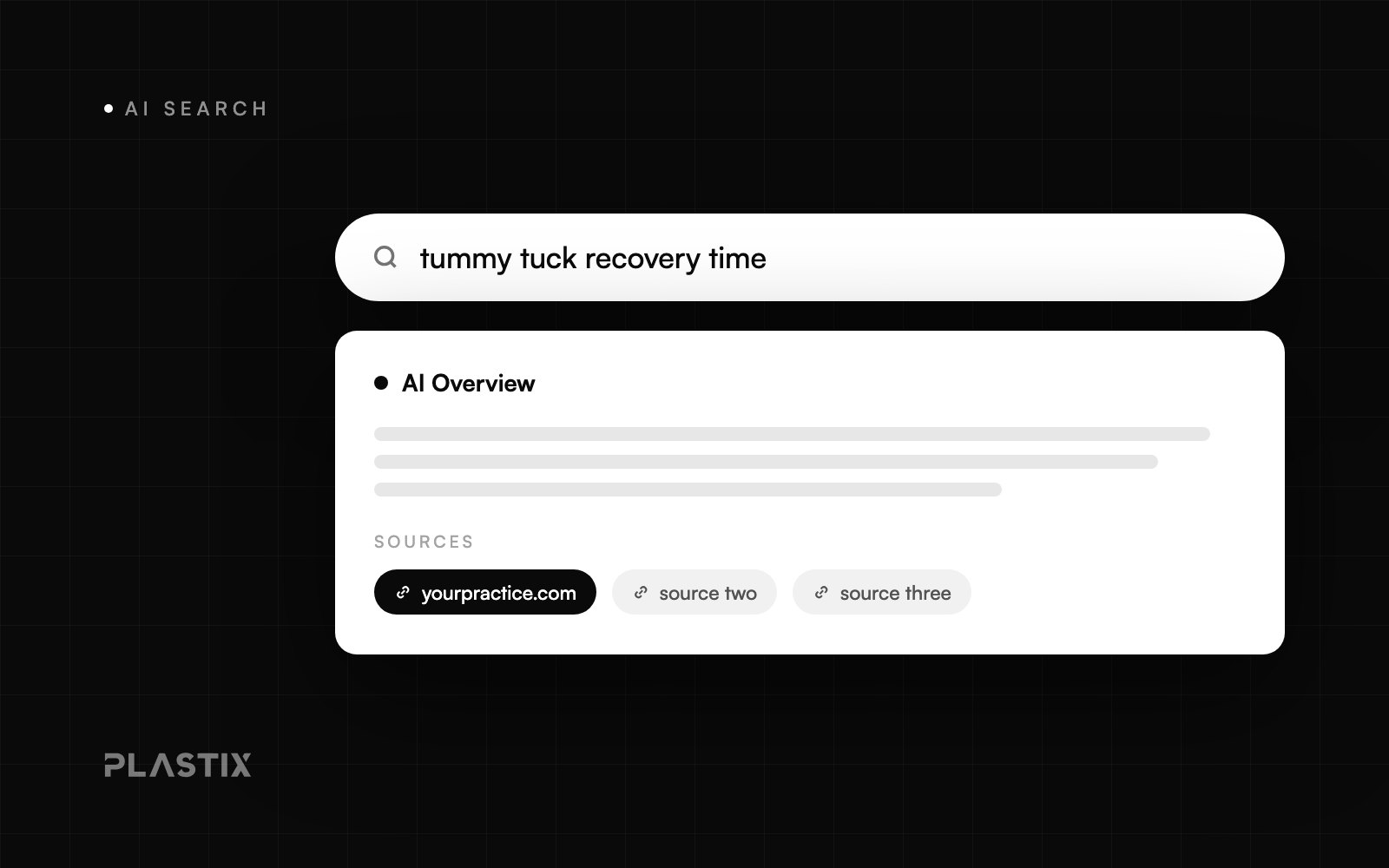
To show up in Google AI Overviews, your page has to be indexed and eligible to appear in regular Google Search with a snippet. Beyond that, Google says there is no special markup, file, or technique required. For a plastic surgeon or med spa, the practical path is clear procedure pages, a strong Google Business Profile, and visible proof of who is providing care.
What Are Google AI Overviews and AI Mode?
AI Overviews are the AI-written summaries that appear on some Google results pages, with links to the pages Google used as sources. Google describes them as a way to get the gist of a complicated question quickly, and says they only show when its systems decide they add something to the standard results.
AI Mode is Google's more conversational search experience. It is built for questions that need more reasoning or comparison, and people can keep asking follow-up questions instead of starting a new search each time.
Both use what Google calls "query fan-out." Instead of running one search, Google runs several related searches across subtopics and pulls supporting pages from each. A patient asking whether a mini tummy tuck is right for them might trigger related lookups about recovery, cost, and who qualifies. A thorough page can be cited for questions the patient never typed.
What Does Google Say It Takes to Appear?
Google's Search Central documentation is unusually direct on this:
- The eligibility bar is regular Search. A page must be indexed and eligible to be shown in Google Search with a snippet.
- There are no extra requirements. Google says you don't need new machine-readable files, AI text files, or special schema.org markup to appear.
- It is still SEO. Google's guide on generative AI search says its AI features are rooted in its core Search ranking and quality systems, and that optimizing for them is still SEO.
- You don't need to chop up your content. Google says there's no requirement to break content into tiny pieces, and no need to write in a special way for AI.
- Your site must be included. Search Console now has a "Search generative AI" setting. Sites are included by default, but a site set to exclude will not get impressions or traffic from AI Overviews or AI Mode.
- Nothing is guaranteed. Google states that meeting every requirement does not guarantee crawling, indexing, or serving.
The takeaway: be skeptical of anyone selling secret AI Overview markup or a special file that "gets you in." The work is good SEO done carefully, which we explain further in AEO vs. SEO for plastic surgeons and med spas.
Build Procedure Pages That Answer Real Patient Questions
Google's guidance leans hard on what it calls non-commodity content: pages with a unique perspective or first-hand insight. A generic "What Is Rhinoplasty?" page that reads like every other surgeon's site gives Google little reason to cite you.
Your procedure pages should answer patients' specific questions directly, near the top, in plain language:
- Cost. A realistic range for a tummy tuck or breast augmentation in your market, and what the fee includes (surgeon, anesthesia, facility, follow-up visits).
- Recovery. When patients typically return to desk work, exercise, and normal routines, based on your own protocol.
- Candidacy. Who is a good fit, who isn't, and when a different treatment (CoolSculpting instead of liposuction, for example) might make more sense.
- Results and risks. What changes to expect and over what timeline, with honest discussion of risks. Never promise outcomes.
Your surgeon's approach, your recovery instructions, and the questions your consult coordinators hear every week are content nobody else can copy. Our plastic surgery SEO work starts here for that reason.
Why Your Google Business Profile Matters for AI Search
A lot of aesthetic searches are local: "lip filler near me," "best Botox in Scottsdale," "med spa near me." Google's AI search guide says generative AI responses can include information about local businesses, and that Google Business Profiles can help your services stay visible in both AI responses and regular results.
Google's own local ranking help page names three factors: relevance, distance, and prominence. It also says more reviews and positive ratings can help local ranking, and that there is no way to pay for a better local position. In practice that means:
- Pick accurate primary and secondary categories, and list every service you offer.
- Keep hours, address, phone, and booking links current.
- Add real photos of your office, team, and treatment rooms.
- Ask every patient for a review, not just the happy ones. Google's policies prohibit offering discounts, free treatments, or other incentives for reviews, and prohibit selectively asking only satisfied patients.
For med spas, this profile is often the first thing Google has to work with, which is why our medical spa SEO work treats it as core infrastructure.
Structured Data: Accurate, Helpful, and No Shortcut
Structured data (schema markup) is code that describes facts like your practice name, locations, providers, and services in a format search engines can read. Google says it isn't required for AI features and there's no special schema to add, but it still recommends using it because it helps with eligibility for rich results.
The rule that matters most: your structured data has to match what patients can see on the page. Google's AI features documentation calls this out directly, and its general structured data policies say not to mark up content that isn't visible to readers.
Be wary of old advice about FAQ schema. Google stopped showing FAQ rich results in Search in 2026, and no schema type guarantees a spot in an AI Overview. Mark up what is true and visible, then focus on the content.
Make Your Expertise Easy to Verify
Aesthetic procedures are health decisions, and Google treats them that way. Its guidance on helpful content says its systems give more weight to content showing strong experience, expertise, authoritativeness, and trustworthiness (E-E-A-T) on topics that could affect people's health. Google also notes E-E-A-T is not a single ranking factor, so think of it as a set of signals your site should make obvious:
- A byline or "medically reviewed by" line on procedure and blog content, naming the provider.
- Provider bio pages with board certifications, training, memberships, and years in practice.
- Consistent names and credentials across your website, Google Business Profile, and directory listings.
- Real before-and-after photos, published with patient consent. Google's AI guide notes its generative features can bring in relevant images and video.
How to Check Whether You Show Up in AI Overviews
Google Search Console. The Generative AI performance report shows impressions from AI Overviews and AI Mode, broken down by page, country, device, and date. Google rolled it out to all sites worldwide on August 31, 2026. It does not currently show clicks or the searches that triggered each impression, but it shows which pages are being pulled in.
Rank tracking tools. SEMrush's Position Tracking shows which of your tracked keywords trigger an AI Overview and whether your domain is cited. Organic Research shows how many keywords a domain is cited for in AI Overviews. One quirk: when you are cited, Position Tracking records that as a #1 position even if your regular listing sits lower.
Treat third-party data as a sample: Google cautions that no outside tool has access to its internal ranking or AI systems. We track our own site the same way. As of September 2026, SEMrush shows Plastix inside Google's AI Overview for 43 search terms, 8.7% of the keywords we rank for.
What to Do This Week
- In Search Console, confirm the "Search generative AI" setting includes your site, then check which pages already earn impressions.
- Run your top five procedure pages through URL Inspection and confirm each is indexed, and have your developer confirm none carry noindex or nosnippet tags.
- Write down the ten questions patients ask most about your top procedure, and check whether the page answers each one clearly.
- Update your Google Business Profile categories, services, and photos, and set up a review request that goes to every patient.
- Add a provider byline and link to a credentials page on each procedure page.
- Add 20 to 30 procedure-plus-city searches to a rank tracker that reports AI Overview presence.
Where Plastix Fits
Google is one piece of AI search. ChatGPT works differently, and we cover it in how to get your practice recommended by ChatGPT.
Nobody can promise a spot in an AI Overview. What we can do is make sure your site, your Google Business Profile, and your content give Google every reason to cite you. If you want to see where you stand today, learn about our AI search optimization service or book a consultation.
Frequently Asked Questions
Do I need special schema markup to appear in Google AI Overviews?
No. Google's documentation says there is no special schema.org structured data you need to add to appear in AI Overviews or AI Mode, and no special AI files are required. Structured data is still worth using because it can make pages eligible for rich results, but it must match the content visitors can see. No schema type, including FAQ markup, guarantees your practice will be cited.
Is Google AI Mode different from AI Overviews?
Yes. AI Overviews are AI-written summaries that appear on some regular Google results pages. AI Mode is a separate, more conversational experience built for complex questions and comparisons, where people can ask follow-up questions. Google says both use the same eligibility rules and both rely on its core Search ranking and quality systems, so the same work on your website and Google Business Profile supports visibility in each.
Will ranking first on Google put my practice in the AI Overview?
Not automatically. Strong SEO matters, because Google says its AI features are rooted in the same ranking and quality systems as regular Search. But AI Overviews only appear on some searches, and Google can pull supporting pages from several related searches it runs behind the scenes. Your best approach is a page that answers the specific patient question clearly and completely, backed by solid overall SEO and a well-maintained Google Business Profile.
Should my practice opt out of AI Overviews in Search Console?
For most practices, no. Google's Search generative AI setting lets sites exclude themselves, but excluded sites do not receive impressions or traffic from AI Overviews or AI Mode. Google says opting out does not affect how a site appears in regular Search results. Staying included keeps your pages eligible to be cited when patients research procedures through these features, which is usually the better choice for a practice that wants new consultations.
How can I tell if my practice is cited in an AI Overview?
Start with the Generative AI performance report in Google Search Console, which shows impressions from AI Overviews and AI Mode by page, country, device, and date. It does not currently show clicks or search terms. For keyword-level detail, rank tracking tools such as SEMrush Position Tracking report which tracked searches show an AI Overview and whether your site is cited as a source.
Related Services