AEO vs. SEO: What Plastic Surgeons and Med Spas Need to Know
SEO earns your practice a ranking and a click. AEO earns a mention inside an AI answer. Here's how they overlap and how to split your effort.
Eric Dunn
October 5, 2026
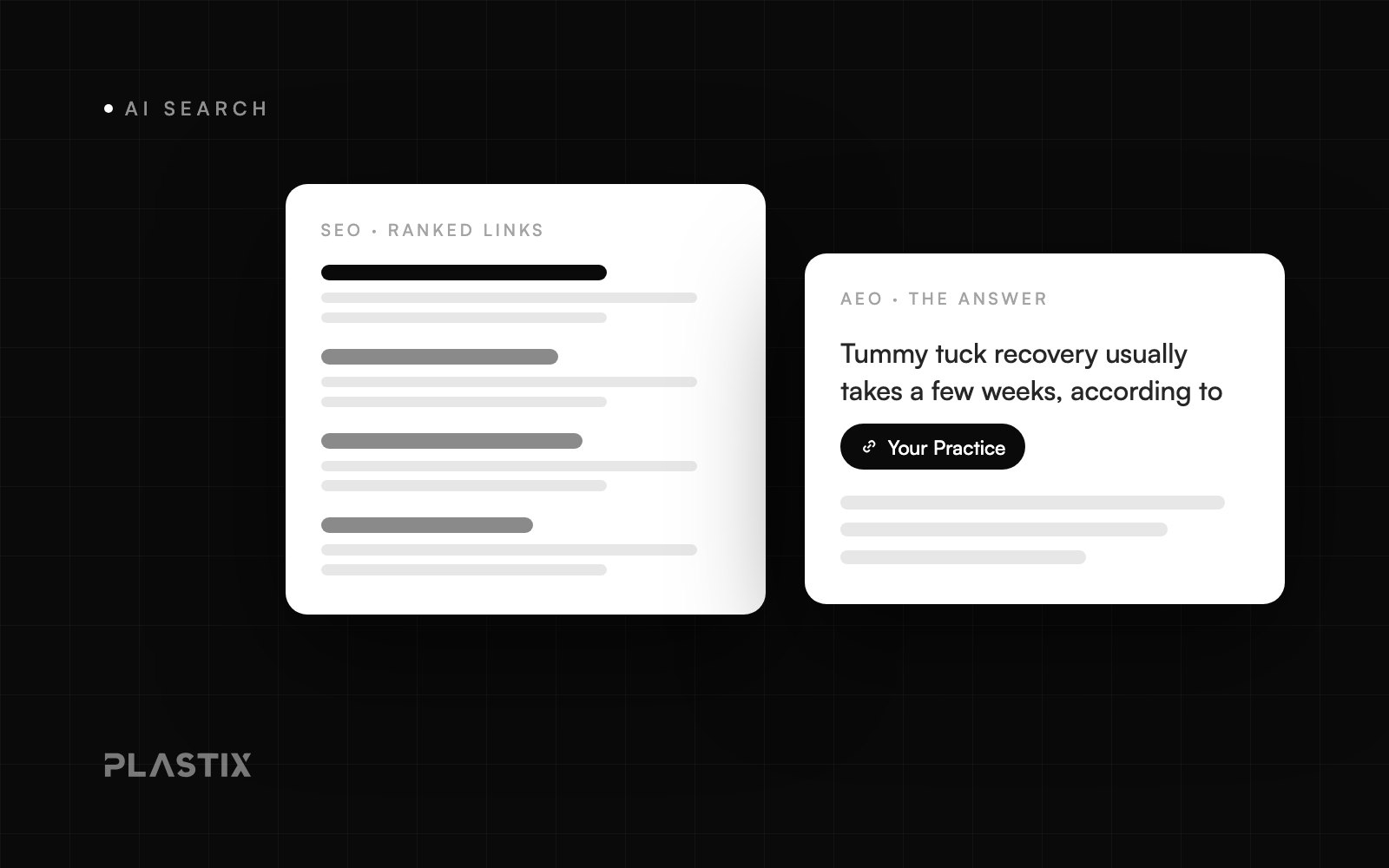
SEO gets your practice ranked in Google so a patient clicks through to your site. AEO (answer engine optimization) and GEO (generative engine optimization) get your practice named or cited inside the answers that ChatGPT, Google's AI Overviews, and similar tools write. They share most of the same foundation, SEO is not dead, and the real differences are in how your content is written, where your name shows up off your website, and how you measure success.
What Is SEO, in Plain English?
Search engine optimization is the work of getting your pages to appear high in Google's results when someone searches "tummy tuck surgeon in Dallas" or "med spa near me." It covers your website's technical health, the content on your procedure pages, your Google Business Profile, your reviews, and the other sites that link to and mention you.
Winning in SEO is easy to picture. You hold a spot on page one, a prospective patient clicks, and they call or book. Everything you measure (rankings, clicks, calls, consult requests) traces back to that visit. Our SEO for plastic surgeons page covers how this works in aesthetics.
What Is AEO (Answer Engine Optimization)?
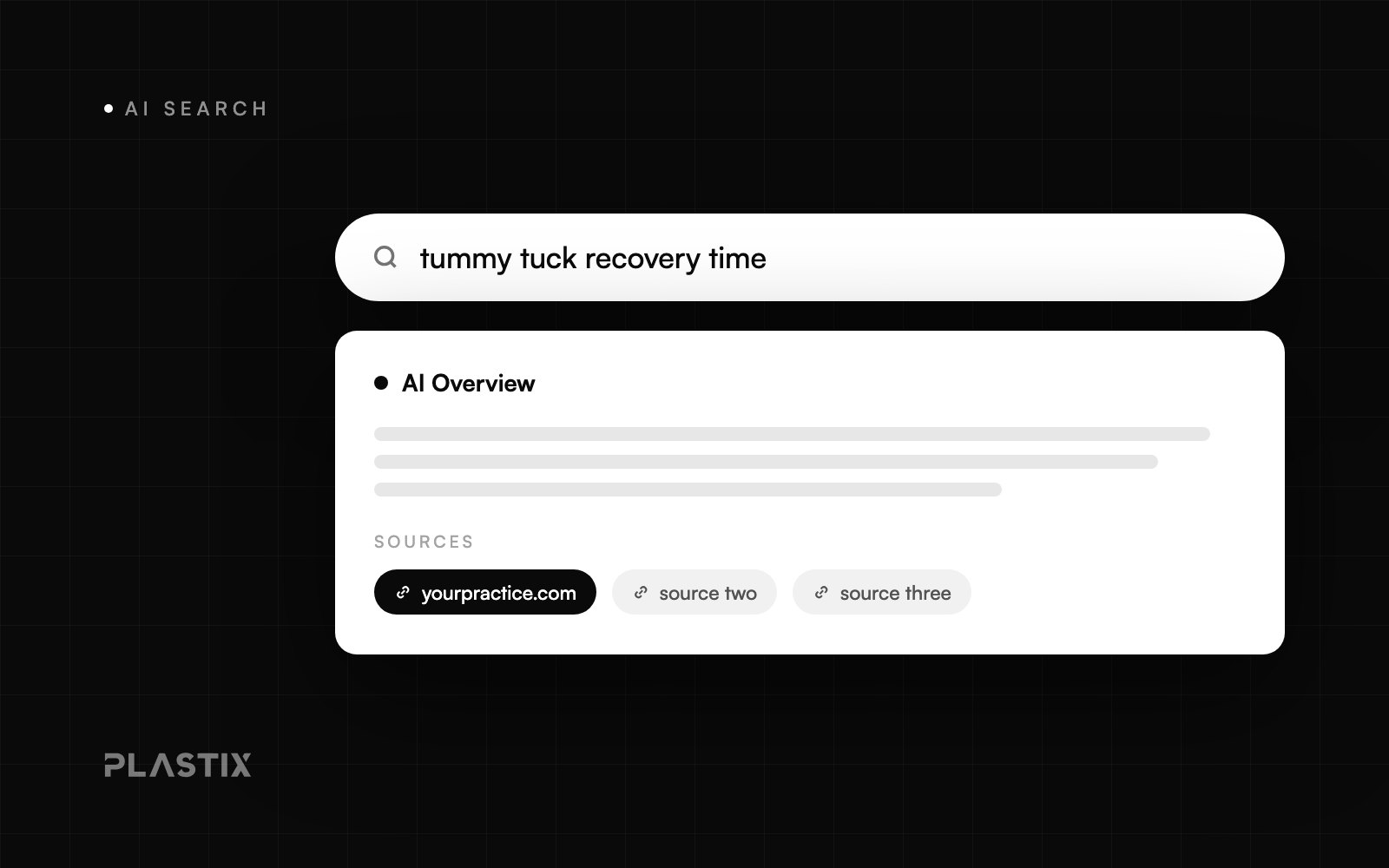
An answer engine is any tool that responds to a question with a written answer instead of a list of links. ChatGPT, Perplexity, Microsoft Copilot, and Google's AI Overviews and AI Mode all fit.
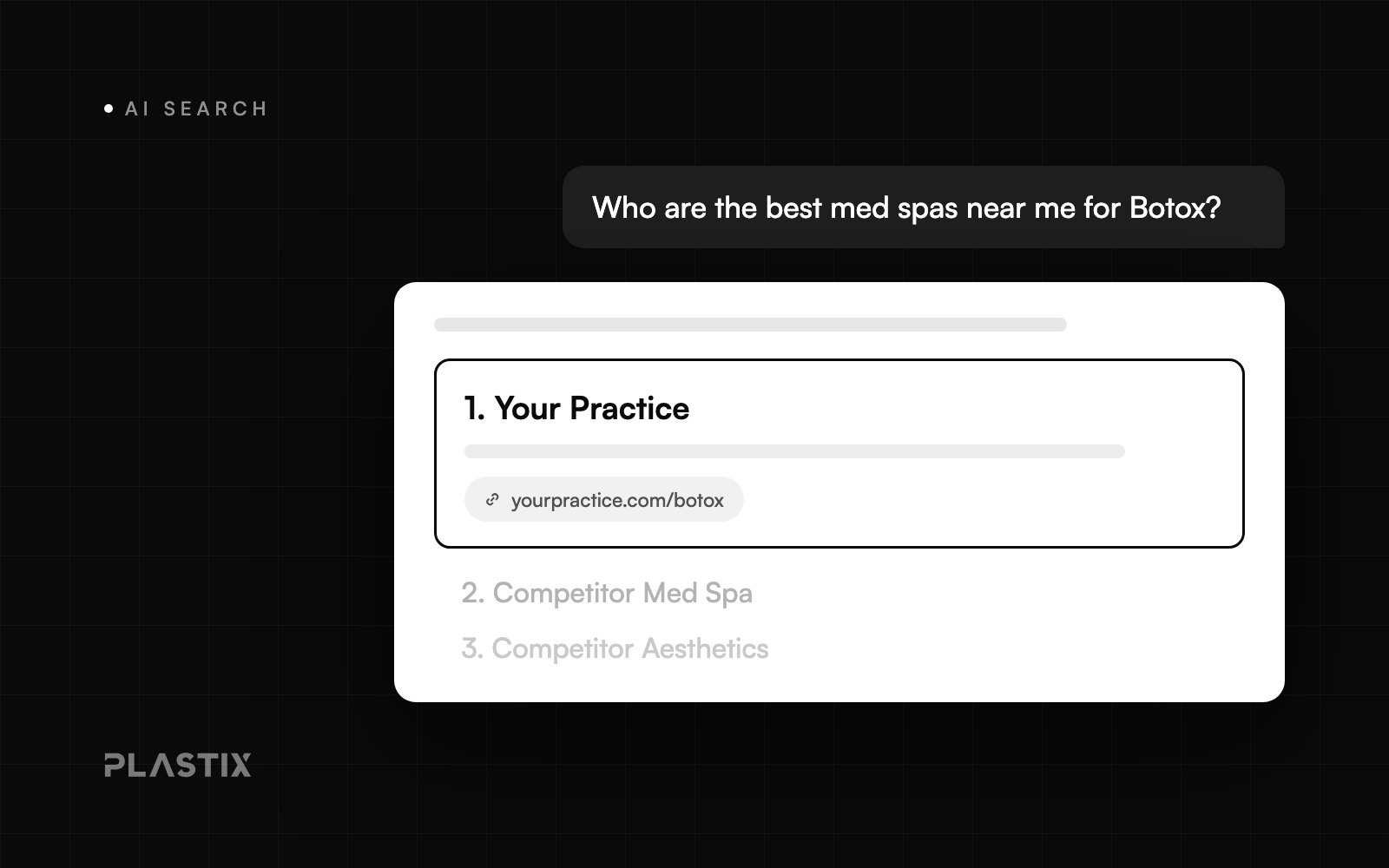
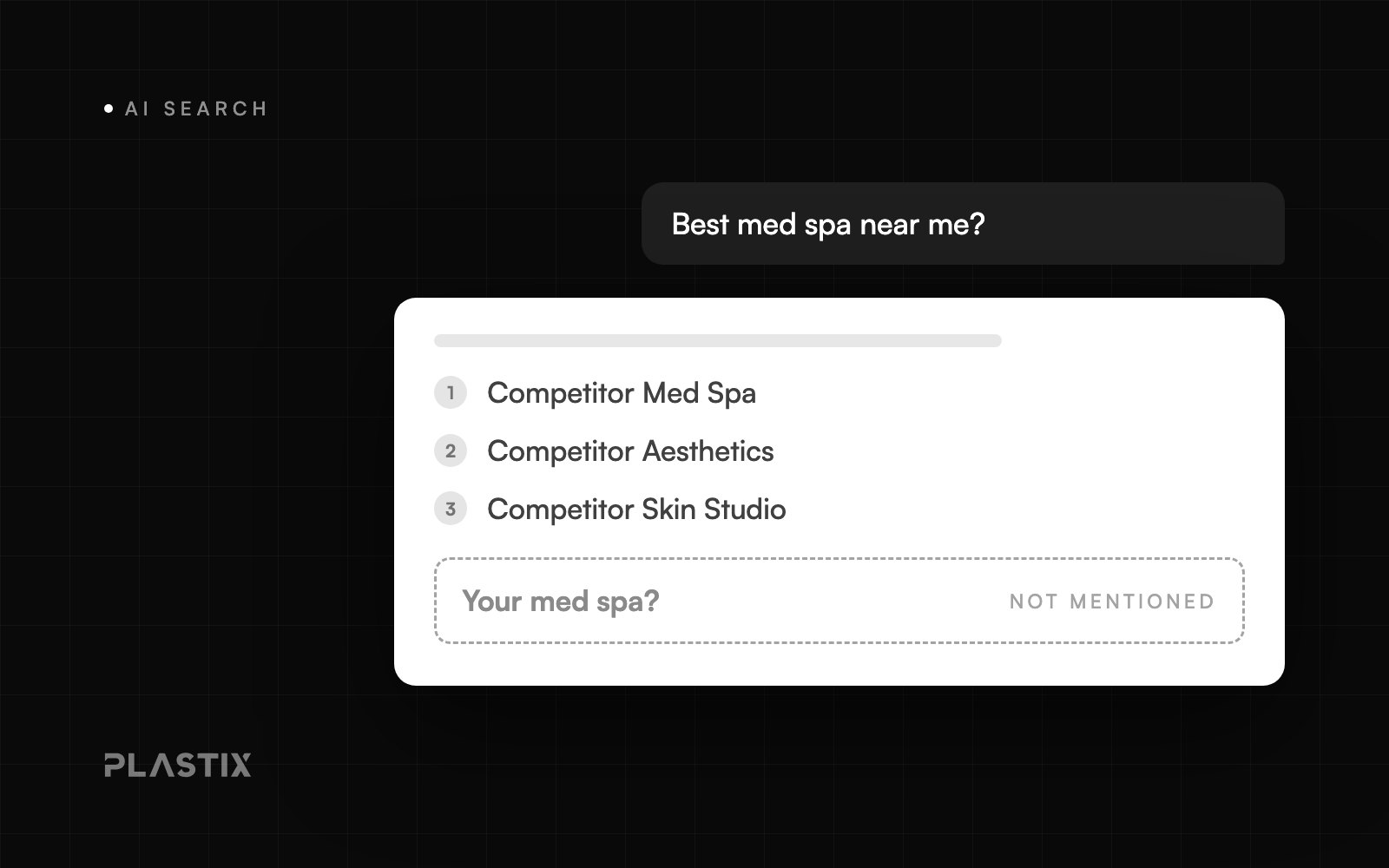
AEO is the work of making your practice the source those tools quote or the name they mention. A patient types "how long is recovery from a deep plane facelift?" or "who does natural-looking lip filler in Scottsdale?" and the answer either includes you or it doesn't.
What Is Generative Engine Optimization (GEO)?
GEO is a close cousin of AEO. The term comes from a research paper first posted in November 2023 and accepted to KDD 2024, a major data science conference, which described "generative engines" as search tools that use AI models to gather and summarize information.
In practice, marketers use AEO and GEO almost interchangeably. For a practice owner the distinction doesn't change what you should do, so don't let an agency sell them as two separate products.
Where Do AEO and SEO Overlap?
Most of the foundation is shared, and Google says so directly. Its guidance on AI features states there are no additional requirements to appear in AI Overviews or AI Mode, and that the same foundational SEO best practices apply. To show up as a supporting link, a page has to be indexed and eligible to appear in Google Search with a snippet. That is SEO.
ChatGPT works differently, though it still connects to search. OpenAI says its search feature draws on third-party search providers along with its own crawler, called OAI-SearchBot.
Here is what serves both goals:
- A site search engines can crawl and index, that loads fast on a phone
- Procedure pages written in real text that clearly explain the treatment, who it's for, recovery, and what affects cost
- An accurate, complete Google Business Profile with consistent name, address, and phone number everywhere
- Real reviews from real patients, requested ethically (Google's policies prohibit offering discounts or free services in exchange for reviews)
- Mentions and links from credible sites: local press, professional associations, and trusted directories
- Surgeon and provider bios that make credentials easy to find
We see the overlap in our own data. As of September 2026, SEMrush shows Plastix inside Google's AI Overview for 43 search terms, 8.7% of the keywords we rank for.
Where Do AEO and SEO Differ?
They split on what winning looks like and how you prove it.
What winning looks like in SEO:
- Your page ranks for a search like "rhinoplasty Atlanta"
- The patient clicks to your site
- You measure rankings, traffic, calls, and form fills
What winning looks like in AEO and GEO:
- Your practice is named, quoted, or cited inside an AI-written answer
- The patient may never click; they might search your name later or call directly
- You measure how often you appear across many questions, asked many times
Content style shifts too. People ask AI tools longer, more specific questions ("is CoolSculpting worth it if I'm 15 pounds from my goal weight?"), and a page that answers plainly up top is easier to quote than one that buries the answer in marketing copy.
Your reputation off your own site also carries more weight, because an AI answer that recommends a practice is summarizing what the web says about it.
Measurement is the biggest practical difference. Rankings are fairly stable from one search to the next. AI answers are not: a 2026 research paper on AI search visibility found that answers vary across runs, prompts, and time, so one screenshot of ChatGPT naming you (or not) proves very little. Track a set of questions, repeated over weeks.
The tools are catching up. As of August 31, 2026, every site has a Generative AI performance report in Search Console showing how often its pages appeared in AI Overviews and AI Mode (impressions, with the two features combined). Bing Webmaster Tools added an AI Performance report, in public preview since February 2026, that shows citations in Copilot and Bing's AI summaries.
Is SEO Dead?
No. Google's AI Overviews and AI Mode pull supporting links from indexed pages, and ChatGPT's search leans partly on outside search providers. A practice with a weak site and thin procedure pages gives these systems little to find.
What has changed is the path to a patient. Simple questions, like "how long does Botox last," can now be answered on the results page or in a chat window, so a ranking doesn't always produce a visit. SEO's job has expanded to include being the source AI tools trust, and your reporting should reflect that.
How Should Your Practice Split Its Effort?
Skip the fixed percentage. Split it by where you are today.
- If your SEO foundation has gaps (technical errors, missing procedure pages, few reviews, weak local rankings), fix those first. AEO work built on a shaky site rarely shows results.
- If you already rank well locally, add the AEO layer: rewrite key procedure pages to answer real consult questions directly, clean up your directory listings, and track AI answers for your top treatments.
- If you have a limited budget, don't buy AEO as a separate retainer that duplicates your SEO program. Most of the work should happen inside one plan.
For the tactical side, read how to show up in Google AI Overviews and how to get your practice recommended by ChatGPT.
What Should You Ask an Agency That Pitches AEO or GEO?
Good questions to ask:
- What will you do that my current SEO program doesn't already cover?
- Which patient questions will you track, in which AI tools, and how many times will you run each one?
- Will your reports include Search Console's Generative AI report and Bing's AI Performance report?
- Will you show me every change you make to my website and listings?
Red flags:
- Guaranteed placement in ChatGPT or AI Overviews. Google states that no one can guarantee a #1 ranking, and nobody controls AI answers.
- Claims of a special relationship with OpenAI, Google, or any AI company.
- An "AI file" as the main deliverable. Google says you don't need new machine-readable files or AI text files to appear in AI Overviews or AI Mode.
- Proof by screenshot. One ChatGPT answer is not a trend.
- Shortcuts that break the rules: fake or incentivized reviews, planted Reddit posts, or hundreds of thin AI-written pages.
What to Do This Week
- Open Search Console and look at the Generative AI performance report to see which of your pages already appear in AI features
- Confirm no one has used Search Console's new generative AI control to exclude your site from AI Overviews and AI Mode by mistake
- Have your web team confirm robots.txt isn't blocking Googlebot or OAI-SearchBot (OpenAI says sites that opt out of OAI-SearchBot won't be shown in ChatGPT search answers)
- Write down five questions patients ask in consults, ask each one in ChatGPT and Google AI Mode three times, and note who gets named
- Pick your top three procedure pages and make sure each answers candidacy, recovery, and cost factors in plain sentences near the top
Where Plastix Fits
We work only with plastic surgeons, med spas, and dermatologists, and we run SEO and AEO as one program because the foundation is the same. To see where your practice stands in Google and in AI answers, look at our AI search optimization approach or book a consultation. We'll show you what we find, including what nobody can control.
Frequently Asked Questions
What is the difference between AEO and SEO?
SEO aims to rank your pages in search results so patients click through to your website. AEO, or answer engine optimization, aims to get your practice quoted, cited, or named inside answers written by AI tools like ChatGPT and Google's AI Overviews. Both depend on the same foundation: a crawlable website, clear procedure content, an accurate Google Business Profile, and real patient reviews. They differ in what success looks like and how you measure it, since an AI mention may never produce a click.
What is generative engine optimization?
Generative engine optimization, or GEO, is the practice of improving how often a business or its content appears in answers generated by AI search tools. The term was introduced in an academic paper first posted in November 2023. Most marketers now use GEO and AEO to mean nearly the same thing. For a plastic surgery practice or med spa, the work overlaps heavily with good SEO, plus clear question-and-answer content and consistent information about your practice across the web.
Is SEO dead because of AI search?
No. Google says pages must be indexed and eligible to appear in regular search with a snippet before they can show as supporting links in AI Overviews or AI Mode, and ChatGPT search draws partly on third-party search providers. SEO remains the entry point for AI visibility. What has changed is that some simple questions get answered without a click, so practices should track AI mentions and impressions alongside rankings and website traffic.
Will AI replace SEO for medical practices?
AI is changing SEO more than replacing it. Patients still search for providers, read reviews, and compare practices, and AI tools still rely on websites and search indexes to form their answers. What shifts is the emphasis: direct answers to patient questions, a consistent reputation across review sites and directories, and measurement that includes AI features. A practice that drops SEO entirely would give AI tools less to find and less reason to mention it.
Can an agency guarantee my practice will be recommended by ChatGPT?
No. No one controls what ChatGPT, Google AI Overviews, or other AI tools say, and answers can change from one run to the next. Google has long warned that no one can guarantee a top ranking, and AI answers are less predictable than rankings. A credible agency will explain what it will improve, which questions it will track, and how it will report results over time, without promising a specific placement or recommendation.
Related Services